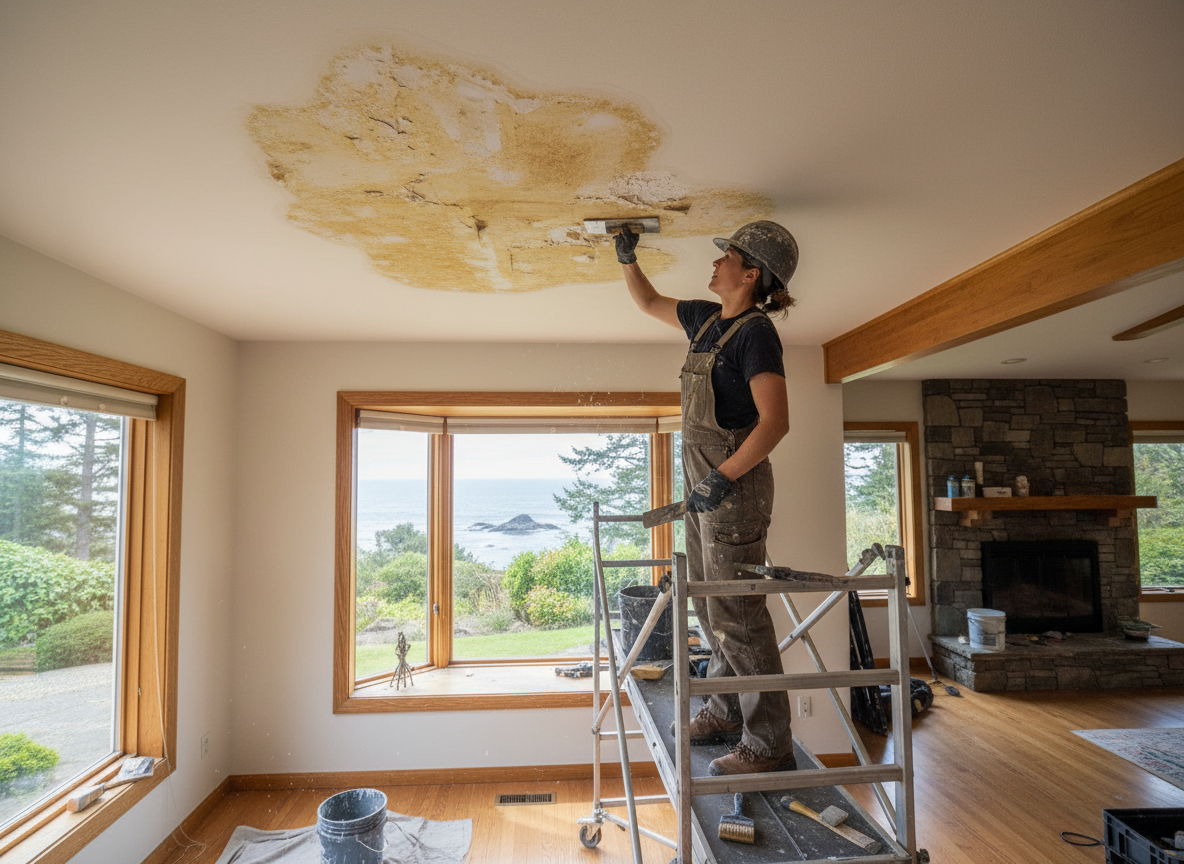
Seahurst homes built before 1970 often feature plaster-over-lath ceilings that allow water to travel far from the entry point before sagging becomes visible. Heavy winter rains combined with aging asphalt shingles on these single-story ranch houses create slow roof leaks that saturate insulation and framing. Technicians must remove sections of ceiling without disturbing adjacent areas that still appear dry, then use moisture meters to trace hidden migration along joists. Failure to map the full wet zone leads to recurring stains months later when humidity rises again in spring.
Once the source is isolated, drying focuses on the attic space above the ceiling where ventilation is often poor in Burien’s older stock. Industrial air movers and dehumidifiers run for several days while monitoring wood moisture content to stay below 15 percent before new drywall or plaster patch work begins. In many cases the original texture cannot be matched exactly, so the repair includes feathering new compound into surrounding areas and repainting the entire ceiling plane to avoid visible seams. King County permit rules require documentation of structural members that were wetted if the affected area exceeds ten square feet.
Homeowners sometimes attempt spot repairs with paint alone, but the underlying wet drywall or plaster will continue to support mold growth in the region’s consistently damp climate. Proper protocol includes removing all saturated material back to dry substrate, treating any visible microbial growth with EPA-registered solutions, and installing new moisture-resistant drywall where code allows. Final air-quality checks confirm that no elevated spores remain before the ceiling is closed and textured.
Technician insight
In Seahurst, the thing that catches most people out with Ceiling water damage repair is how rainwater travels along the underside of the roof deck in these 1950s homes before dripping into the ceiling near interior walls rather than directly under the leak, so homeowners often point us to the wrong spot and we have to trace it back through the attic during a rain event.
Attic Pipe Leak in Seahurst
Water stains appeared on the living-room ceiling after several days of rain. Inspection found a pinhole leak in an upstairs bathroom supply line that had been running along ceiling joists for weeks. Saturated insulation and drywall were removed, the line was repaired, the cavity dried for four days, and a new drywall patch was installed and painted to match the surrounding ceiling.
How it works
- 1
Source Identification
Technicians inspect the attic, roofline, and plumbing above the ceiling using moisture meters and thermal imaging to locate the exact entry point without unnecessary demolition.
- 2
Containment and Removal
Affected ceiling sections are isolated with plastic sheeting, then cut out to the nearest dry framing while protecting floors and belongings below.
- 3
Drying and Treatment
Industrial equipment dries the cavity and any exposed joists; antimicrobial application follows if mold is present.
- 4
Repair and Finish
New drywall or plaster patch is installed, taped, textured to blend with the original ceiling, and painted to eliminate visible repair lines.
Pricing
Cost depends on square footage affected, whether plaster or drywall is present, and any structural drying required; upfront written quotes provided before work begins.