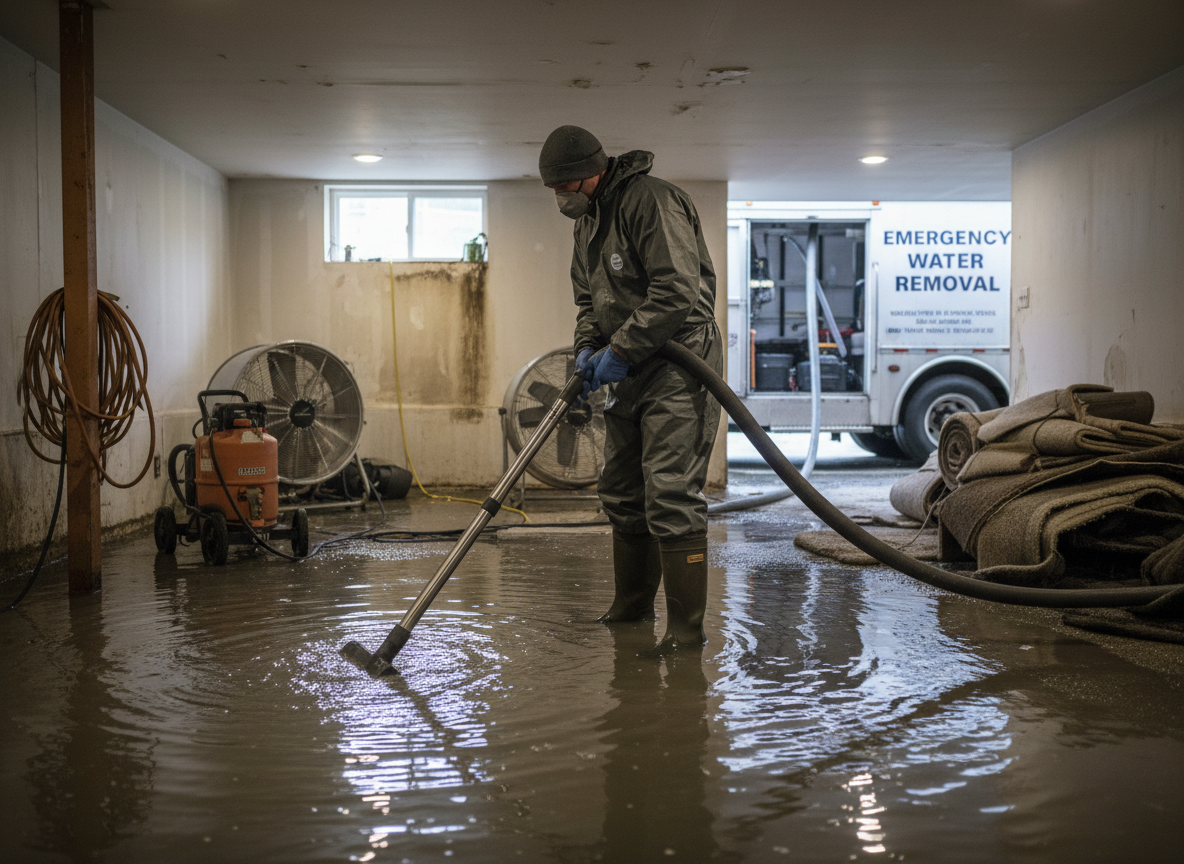
Seahurst sits in the low-lying parts of Burien where winter rains from Puget Sound frequently overwhelm older drainage systems. Many homes built before 1970 have crawlspaces or partial basements set directly on native glacial till that holds moisture against sill plates. When surface water enters through foundation cracks or failed sump pumps, it travels laterally along the slab edge and saturates insulation and subfloor framing within hours. Emergency water removal crews must first isolate the source, then use truck-mounted extraction units to pull standing water before it migrates into wall cavities or under cabinets.
Once bulk water is removed, the real work shifts to hidden moisture trapped in the particleboard underlayment common in Seahurst ramblers. Technicians place moisture meters at multiple depths along the perimeter and behind baseboards to map the affected zone. In King County’s damp climate, relative humidity often stays above 70 percent for days after a storm, so industrial air movers and dehumidifiers run continuously until readings drop below 12 percent on wood. Failure to reach these levels allows hidden mold colonies to form on the back side of drywall within 48 to 72 hours.
Local terrain adds another layer: many streets slope toward the Sound, so water from neighboring lots funnels against shared property lines. Crews frequently encounter shared drainage swales clogged with leaves and sediment that redirect flow into the lowest foundation. Extraction plans must account for these off-site contributors, or the same volume returns with the next rainfall. Documenting moisture gradients and removing saturated base trim allows homeowners to see exactly where the water traveled before walls are closed.
Technician insight
In Seahurst, the thing that catches most people out with Emergency water removal is the way clay lenses in the glacial till trap water against the outside of older concrete foundations for days after the rain stops. Homeowners often think once the floor is dry the job is done, but the back side of the sill plate stays wet and starts rotting the rim joist before anyone notices.
Crawlspace Flood After Heavy Rain
A Seahurst homeowner near 152nd Street called after overnight rain sent water under the house through a cracked foundation vent. Extraction removed several inches of standing water and saturated insulation. Drying equipment ran for four days until joists tested dry, preventing mold on the subfloor.
How it works
- 1
Arrival and Source Control
Technician arrives within the hour, locates the water entry point, and stops further inflow using shutoffs or temporary barriers.
- 2
Standing Water Extraction
Truck-mounted pumps and wands remove bulk water from floors and low areas before it soaks deeper into subfloor materials.
- 3
Moisture Mapping
Infrared cameras and pin meters locate hidden saturation in walls, cabinets, and underlayment throughout the Seahurst structure.
- 4
Drying and Monitoring
Air movers and dehumidifiers run until wood moisture content reaches safe levels, with daily readings recorded for the homeowner.
- 5
Final Cleanup
Equipment removal, disposal of unsalvageable materials, and a walkthrough confirming the space is dry before any reconstruction begins.
Pricing
Cost varies with water volume, affected square footage, and number of drying days required; upfront quotes provided on site before work begins.