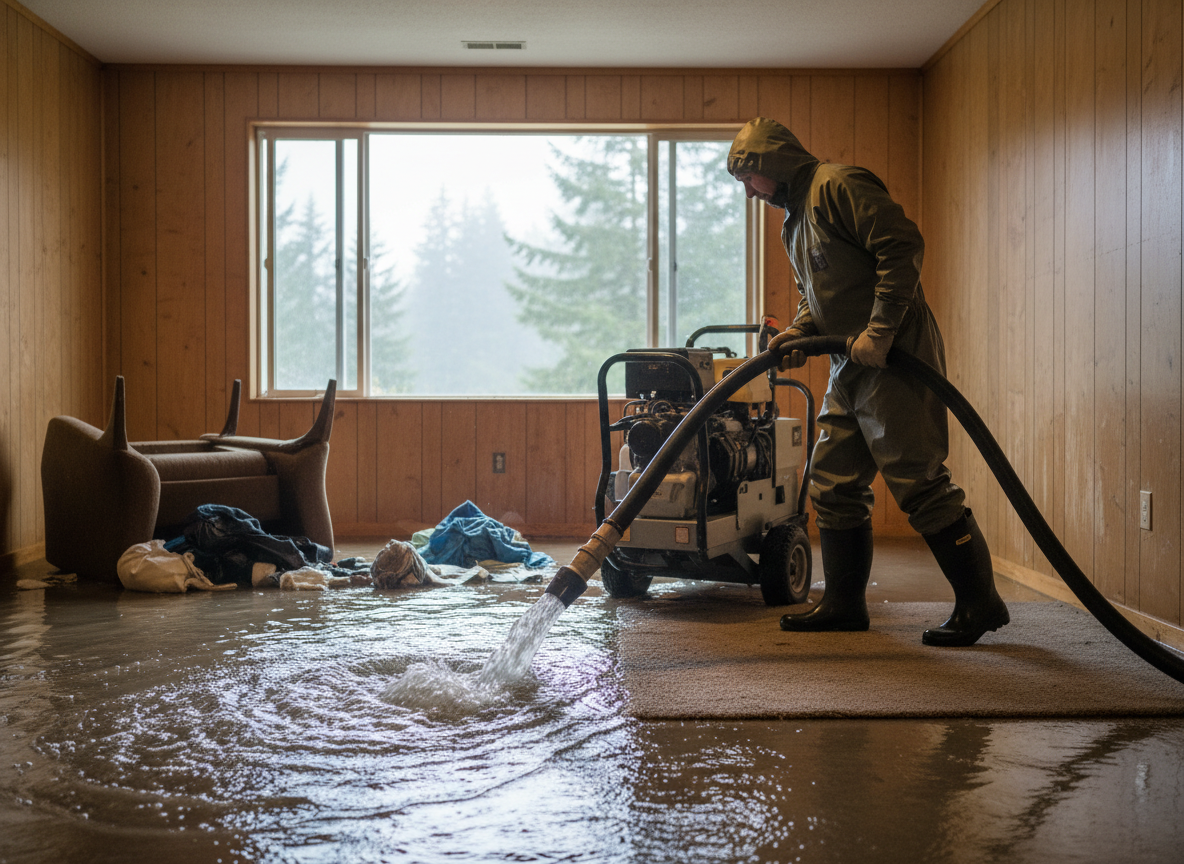
Seahurst homes sit on clay-rich glacial till that traps moisture after heavy rains common to the Puget Sound lowlands. When a pipe bursts or a roof leak hits during the wet season, water migrates laterally under slabs and into crawl spaces faster than in sandy soils farther east. Rapid extraction must begin within the first hours to keep drywall from wicking moisture upward and to limit mold growth on particleboard subfloors typical in 1960s-1980s ranch houses along Ambaum and 4th Avenue SW.
Technicians use truck-mounted vacuums with 500-plus CFM ratings and weighted squeegees to pull standing water from hardwood and vinyl without lifting finished surfaces. In older Seahurst basements that lack French drains, we often encounter water pooled behind poured-concrete walls; extraction alone is not enough until we relieve hydrostatic pressure through strategic drilling of weep holes. Edge cases include sewage-tainted water from overloaded King County lines during winter storms, requiring separate containment and disposal protocols.
After bulk removal, moisture meters map remaining saturation in insulation and framing so hidden pockets are not left behind. Seahurst terrain slopes gently toward Puget Sound, so gravity often moves water toward neighboring lots; extraction crews must coordinate with adjacent property owners to avoid creating new claims. Work is performed under current Washington State residential building codes for drying documentation before any reconstruction begins.
Technician insight
In Seahurst the thing that catches most people out with rapid water extraction is how the clay soil along the bluff holds water against foundation walls long after the rain stops. Homeowners think once the floor is dry the job is done, but we still have to pull moisture from behind the slab edge or it migrates back into the joists the next storm cycle.
Seahurst Crawl-Space Flood After Heavy Rain
Water entered a 1970s ranch through a cracked foundation vent during a December atmospheric river. We found six inches of standing water over clay soil that had already wicked into the floor joists. Extraction units removed the bulk water in four hours, followed by targeted drying of the subfloor; the homeowner avoided mold growth and full floor replacement.
How it works
- 1
On-Site Assessment
Technician arrives within the service window, locates the water source, and maps affected square footage using moisture meters.
- 2
Water Removal
Truck-mounted extraction units pull standing water from floors, carpets, and hard surfaces while containing any contaminated runoff.
- 3
Targeted Drying Setup
Air movers and dehumidifiers are placed based on meter readings; crawl spaces and wall cavities receive directed airflow.
- 4
Daily Monitoring
Return visits track moisture levels until readings match unaffected materials, with written logs provided to the homeowner.
Pricing
Cost depends on water volume, access difficulty, and whether contamination is present; we provide an upfront scope before work begins.