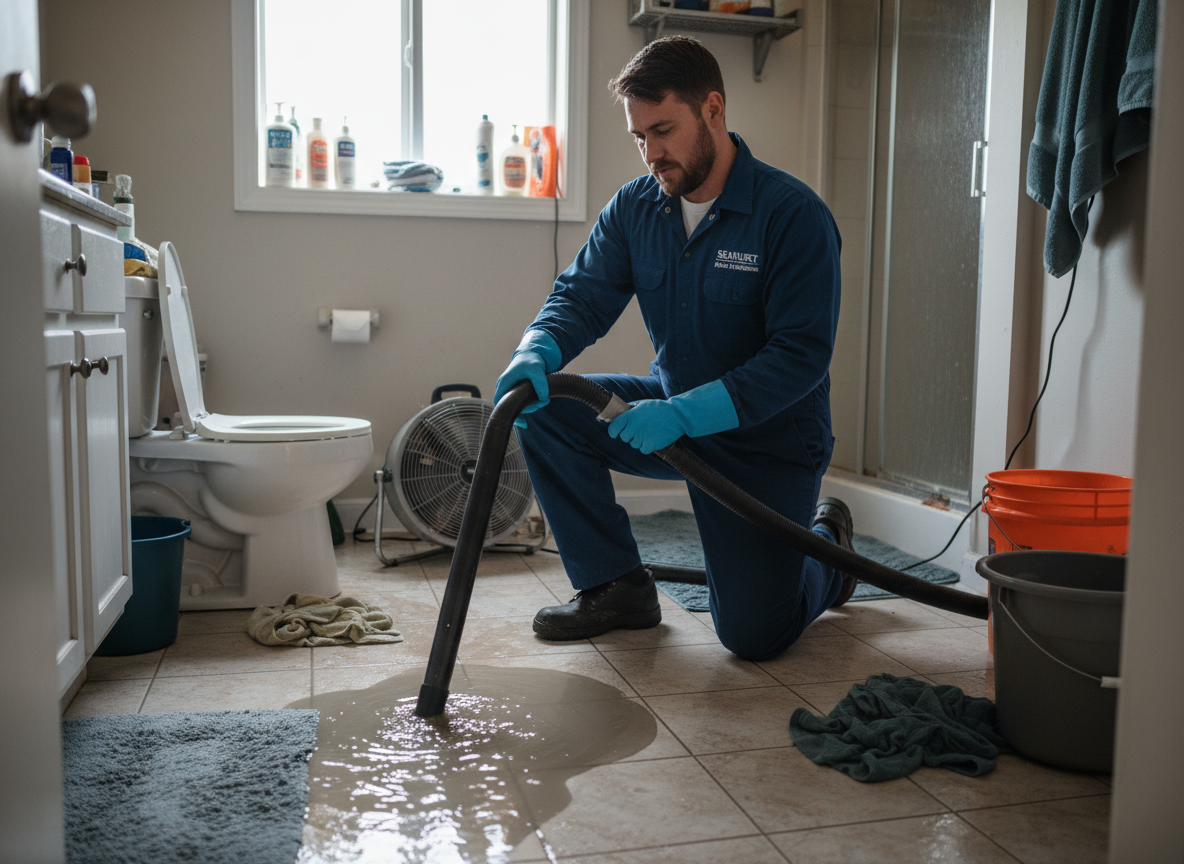
Toilet overflows in Seahurst often reach subflooring in homes built before 1970, where particleboard underlayment absorbs water quickly and swells. Technicians extract standing water first, then use moisture meters to check under baseboards and along the slab edge where King County’s frequent rain keeps ambient humidity high. Leaving even small pockets of moisture leads to mold growth within 48 hours because the marine climate rarely provides enough dry air for natural evaporation.
Bacterial contamination from toilet water demands full removal of affected carpet pads and sometimes sections of hardwood in older Seahurst properties. We apply EPA-registered disinfectants to joists and allow proper dwell time before reinstalling finishes. Homeowners sometimes attempt DIY drying with box fans, but that only moves surface moisture and can push contaminants deeper into wall cavities common in split-level homes along Ambaum Boulevard.
After extraction we document every step for insurance adjusters and place commercial air movers and dehumidifiers sized for the square footage. Final clearance testing confirms moisture levels match unaffected areas before any reconstruction begins. This prevents callbacks that occur when hidden water under vinyl or tile in bathrooms migrates to adjacent rooms during the next heavy rain event.
Technician insight
In Seahurst the thing that catches most people out with toilet overflow cleanup is how fast water travels under the tongue-and-groove hardwood found in many 1960s homes along the ridge; once it reaches the crawlspace edge the clay-heavy soil keeps everything damp for weeks unless we pull baseboards and force air underneath.
Overflow Behind Toilet in Split-Level Home
Water from a cracked wax ring ran under the bathroom floor and into the family room below. We found elevated moisture in the particleboard subfloor and along the exterior wall. After extraction and targeted drying we removed the swollen section, treated the joists, and confirmed dry readings before the homeowner’s flooring contractor reinstalled.
How it works
- 1
Emergency Response
Arrive within the hour, stop the source, and extract standing water using truck-mounted equipment.
- 2
Moisture Mapping
Use meters and infrared cameras to locate water that has traveled under flooring and into walls typical of Seahurst construction.
- 3
Contaminated Material Removal
Remove and dispose of saturated carpet, pad, and affected underlayment while containing odors and bacteria.
- 4
Drying and Sanitation
Set up drying equipment, apply antimicrobial treatments, and monitor until moisture readings return to normal.
- 5
Final Clearance
Perform post-drying inspection and provide documentation for insurance before any rebuilding.
Pricing
Cost depends on square footage affected, type of flooring, and whether subfloor replacement is needed; we provide an upfront written scope before work begins.